

Most teams trying to build something new with AI agents think they’re making a technology choice. They’re actually making a governance choice, and most of the time they don’t know it.
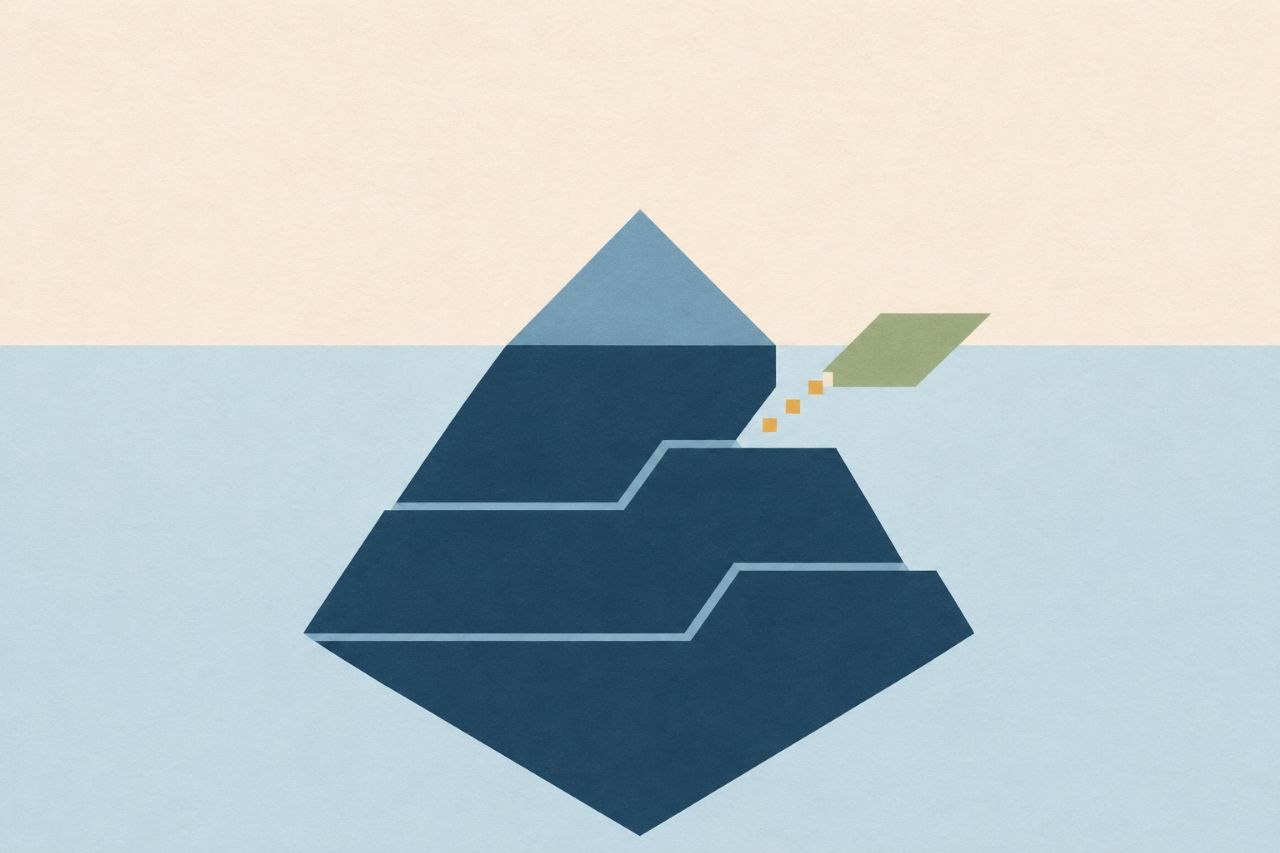
The iceberg beneath the organisation chart
Every team that sets out to build an agentic organisation arrives with a map already in their head of how organisations work: who reports to whom, how decisions get made, what counts as proof of value. That map feels like common sense. It isn’t. It’s an unspoken feudal-industrial iceberg of assumptions, encultured into us through the societies we’re part of — state, state-education, hierarchy — structures that have become so universal we stopped noticing them as choices at all.
The trouble starts when a team says “we’ll do something different” and expects that to be enough. Thousands of years of enculturation into dominance cannot be escaped with a shrug and hope. Saying you want something different doesn’t dissolve the iceberg; it just means you’re building your “different” thing on top of it without looking down.
That’s not an argument for paralysis. It’s possible to map what any organisation system actually needs — governance of some kind, appropriate to its size and age; a shared purpose and values; human-relational processes; and more. The point isn’t that you can’t design deliberately. It’s that you have to see the iceberg before you can choose, consciously, which parts of it you’re keeping and which parts you’re actually replacing.
This matters more, not less, once agents join the team. Rather than waiting for frameworks built in the image of corporate hierarchy and command and control — frameworks that assume a human manager at the top of every decision — it’s worth doing the slower work of understanding the problem-space first, so the structures that get built in are actually chosen, not inherited by default.
Both sides, or neither
There’s a second assumption worth naming, because it sits right next to the first one: the idea that you can solve this from either the technology side or the human side alone.
Silicon Valley doesn’t understand people at a deep level. And the people who do understand people — organisational psychologists, community builders, the ones who’ve spent years learning how trust and belonging actually form — generally don’t understand technology at a deep level either. Each side keeps building solutions that are missing the half they don’t have.
To make agents and humans actually work together, both the human side and the agent side of the organisation need to change, and they need to change in sync. You can’t bolt empathy onto a technical system after the fact, and you can’t design a human-centred culture and then hand it an agent that wasn’t built to hold up its end. Doing this well needs both kinds of understanding in the same room, informing the same decisions, at the same time.
That’s a harder thing to build a company around than picking a tech stack. It means the team itself has to be unusual in the same way the thing it’s building is unusual — people who take both halves seriously, not people who’ve specialised their way out of needing to.
Choosing, instead of inheriting
Put the two together and you get a fairly specific discipline: before building the agent, before building the governance model, before deciding who approves what, ask what assumption you’re carrying in unexamined, and ask whether the humans and the agents in the system are being designed to the same depth of understanding.
None of this is a finished answer. It’s the shape of the question a team has to keep asking itself, project by project, rather than settling once and calling it done. The alternative — building fast, calling it different, and finding out later which parts of the iceberg came along for the ride — is the more common path, and also the more expensive one to correct later.
← All posts